
The Hidden Premise
Universal Peaceful Acceptance and the Claim That the Accepting Church Is Not Catholic

This is the fifth essay in a nine-part series on Universal Peaceful Acceptance (UPA), the principle that the visible Church's universal and peaceful reception of a man as pope gives Catholics public certainty that he is truly pope.
Essay 1 established the prior question: by what authority can a private person or minority set aside the visible Church’s public recognition of a Roman Pontiff? Essay 2 distinguished alleged antecedent incapacity from the public certainty supplied by the Church’s later reception of a man as pope. Essay 3 showed that UPA requires moral universality, not mathematical unanimity or approval of every papal act. Essay 4 addressed the Cassiciacum effort to divide public designation from formal papal jurisdiction.
This essay addresses the deepest attempted exception in the series so far. It grants that UPA presupposes a Catholic accepting Church. It asks whether that presupposition can be defeated by a prior judgment that the ordinarily visible Roman hierarchy no longer constitutes the Catholic accepting Church.
That judgment may appear through a private or minority four-marks analysis, a circularity objection, or a broader claim that the accepting subject has already defected.
The postconciliar crisis is grave. The question is what ecclesiological conclusion follows from it.
The controlling question is this: What public, tradition-grounded rule establishes that grave ecclesial disorder or obscurity of the marks amounts to the actual absence of a necessary mark, with the consequence that the historically continuous Roman body is no longer the Catholic Church?
No such rule has been supplied. Serious evidence of crisis does not by itself establish what is required to determine the Church’s identity anew, declare her marks absent, redraw her visible boundaries, or nullify her public reception of her visible head.
The True Condition and the Unsupported Exclusion
Universal Peaceful Acceptance does not turn a group that follows a papal claimant into the Catholic Church simply because it follows him. A false sect cannot create a Roman Pontiff merely by acclaiming one. A body already established as non-Catholic could not act as the Catholic accepting subject contemplated by the manualist doctrine.
That abstract condition is true. It does not decide the concrete case.
A Catholic accepting Church is required. The disputed question is whether private or minority observers may exclude the historically continuous Roman hierarchy, dioceses, bishops, offices, sacramental life, and juridical communion from that subject before the Church’s reception of a claimant is allowed its ordinary ecclesiological force.
This is the hidden premise. The redefinition move does not merely say that postconciliar acts are troubling, erroneous, destructive, or difficult to reconcile with prior doctrine. It says that the public body organized around the Roman See has ceased to be the Catholic Church in the relevant sense.
Once that conclusion is granted, UPA is defeated by definition. The body that received the claimant is simply declared incapable of receiving anyone as pope.
The conclusion has been placed inside the premise.
The visible Church is not a demographic category assembled through a recurring private test of doctrinal satisfaction. In the ordinary ecclesiological order, she is publicly identifiable as a juridical and hierarchical society through succession, office, communion, sacramental life, juridical continuity, and moral universality. UPA concerns what follows when that publicly identifiable Church receives a man as her visible head.
The manualist framework begins from the visible Church as the Church, not from a requirement that each Catholic audit the hierarchy’s Catholicity anew before every conclave.
A party proposing exceptional exclusion therefore bears the burden of identifying a tradition-grounded rule that states the threshold, identifies the competent evaluator, and gives the resulting conclusion public ecclesial force. Without that rule, the proposed exclusion remains a private conclusion with consequences it has not established the authority to impose.
Here and throughout this series, “private judgment” is jurisdictional, not psychological. It does not mean a conclusion reached from private or secret evidence. It means a conclusion not issued by a publicly competent ecclesial authority, even when it is argued from public texts, public acts, and publicly accessible facts.
S.D. Wright’s Argument from the Four Marks
S.D. Wright of the WM Review advances the most developed current form of the redefinition move in his five-chapter Zero Marks series and its conclusion. His argument should not be reduced to a claim that every Catholic within the postconciliar order is non-Catholic, that the Conciliar/Synodal body is simply a false sect, or that the Church has become literally invisible. Wright expressly disclaims those formulations.
He defines the Conciliar/Synodal Church as the body of men who recognize Leo XIV as pope and spiritual leader, claim submission to him, and are treated by him and his officers as in good standing. His thesis is that this body, considered as a social reality or accidental aggregation, is not identical with the Roman Catholic Church because it contains Catholics and non-Catholics and lacks properties essential to that Church. The visible boundaries of the aggregate, on this view, do not coincide with the boundaries of the Catholic Church. [6]
Wright’s prior visibility argument supplies the conceptual prelude. He distinguishes material, formal, and distinct visibility. He allows that the Church may remain visible despite a grave obscuration of her hierarchy or marks. He also distinguishes the question, “Which is the true Church?” from the question, “Where is the Roman Catholic Church now?” [7]
Those distinctions define Wright’s framework. The present essay does not concede that the marks have been obscured or that the Church’s public identity has become difficult to discern. It grants only that Wright invokes the postconciliar crisis as evidence for those claims. The disputed proposition is stronger: that a private evaluator may convert that evidentiary judgment into a determination that the historically continuous Roman, diocesan, episcopal, sacramental, and juridical structure no longer identifies the Catholic Church at all, then give that determination force against the Church’s reception of her head.
Wright’s thesis goes beyond counting imperfect Catholics. Its central claim concerns an aggregate whose public boundaries are said to misidentify the Church. He develops that claim by treating unity, holiness, catholicity, and apostolicity as necessary properties that must be visibly present in the true Church, then argues that the postconciliar aggregate fails the test across each mark. The argument is architectural. It denies UPA its accepting subject: before the Church’s reception of a papal claimant can supply public certainty, the body that received him is said not to be identical with the Catholic Church.
It is also more exact than a claim that the Church is merely hard to see. In the visibility essay, Wright maintains that the true Church can be materially visible, formally visible in an inadequate and broad way, and distinctly visible despite a severe obscuration. The later Zero Marks argument says that the public structure centered on Rome does not identify that Church. The key move is therefore not from clarity to confusion. It is from obscurity to disidentification.
Wright’s thesis therefore requires more than a showing of obscurity. It requires a public rule by which the ordinarily visible Roman hierarchy can be reclassified as non-identical with the Catholic Church while the Church remains visible, indefectible, juridical, hierarchical, and capable of being identified with ecclesial certainty.
From Crisis Evidence to Ecclesial Reclassification
Any attempt to defeat UPA by excluding the ordinarily visible Roman body from the Catholic accepting Church must pass through more than one inference. Wright’s four-marks argument begins with evidence of crisis and ends with ecclesial reclassification. The chart below identifies the intermediate steps and the further showing required at each one.
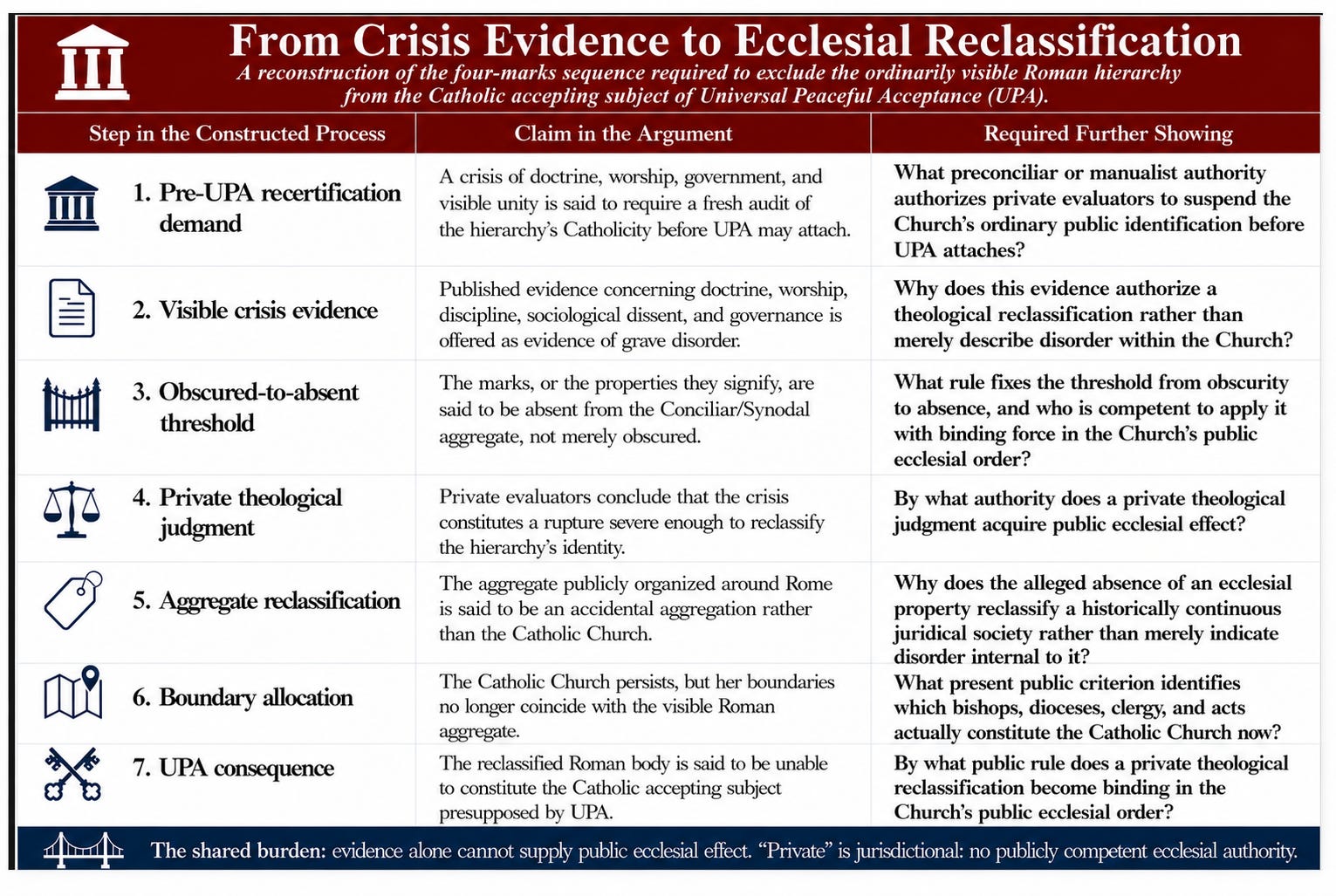
The chart does not dismiss S.D. Wright’s evidentiary case. It separates evidence of crisis from the rules needed to translate that evidence into conclusions about the Church’s identity and authority. Accumulated examples may establish grave disorder, but they do not by themselves determine when disorder becomes loss of ecclesial identity, identify the Church’s remaining public boundaries, or explain how that judgment becomes operative in the Church’s public order. Those transitions require a public, tradition-grounded rule.
The Unproved Rule of Recertification Before UPA
The first transition comes before every later inference. UPA presupposes a Catholic accepting subject, but the visible Church is not a blank slate at each conclave. The manualist framework begins from the Church as a visible, ordered society and explains what follows when that society receives a pope. It does not establish a procedure in which private parties first recertify the hierarchy, dioceses, clergy, and faithful against a privately applied doctrinal threshold before the Church’s reception can count as the act of the Catholic accepting subject.
The narrower question is this: What preconciliar or manualist authority authorizes private evaluators to suspend the ordinary public identification of the visible Catholic hierarchy and require a recertification of its Catholicity before UPA may attach?
Both sides affirm that the marks identify the Church. The dispute is whether a claimed crisis creates an exceptional order in which private recertification comes before the visible Church’s public reception of her head.
Billot supplies no such rule in the passages at issue. He argues from divine impossibility. God cannot permit the whole Church to admit as pontiff one who is not true and legitimate. Once the claimant has been received and joined to the Church as head to body, the alleged absence of a condition necessary for legitimacy is no longer raised because the Church’s adhesion infallibly manifests the required conditions. [1]
Billot’s living-rule language has the same direction. The Church’s adherence to a false pope would be equivalent to adherence to a false rule of faith because the pope is the living rule whom the Church follows in believing. The point is to explain why false universal adhesion is impossible under divine governance. It is not a retrospective quality-of-reception test under which private observers judge whether the visible Church has behaved satisfactorily enough for her earlier reception to count.
John of St. Thomas likewise describes a public order. The Church proposes the elected man to the faithful through election and acceptance. Universal peaceful acceptance is among the means by which she determines canonical election. Once the election has been made and accepted, the required conditions become certain by theological consequence. [2]
Wernz-Vidal and Franzelin secure the same causal order. The Church does not confer papal authority by accepting a claimant. Christ constitutes the true pope. The Church’s acceptance is the divinely protected sign and effect of legitimacy, not a sociological event awaiting a separate private certification of the accepting Church. [3] [4]
The valid condition therefore remains what it was. UPA presupposes a Catholic accepting Church. The exceptional recertification rule has not been supplied.
The Missing Threshold Between Obscurity and Absence
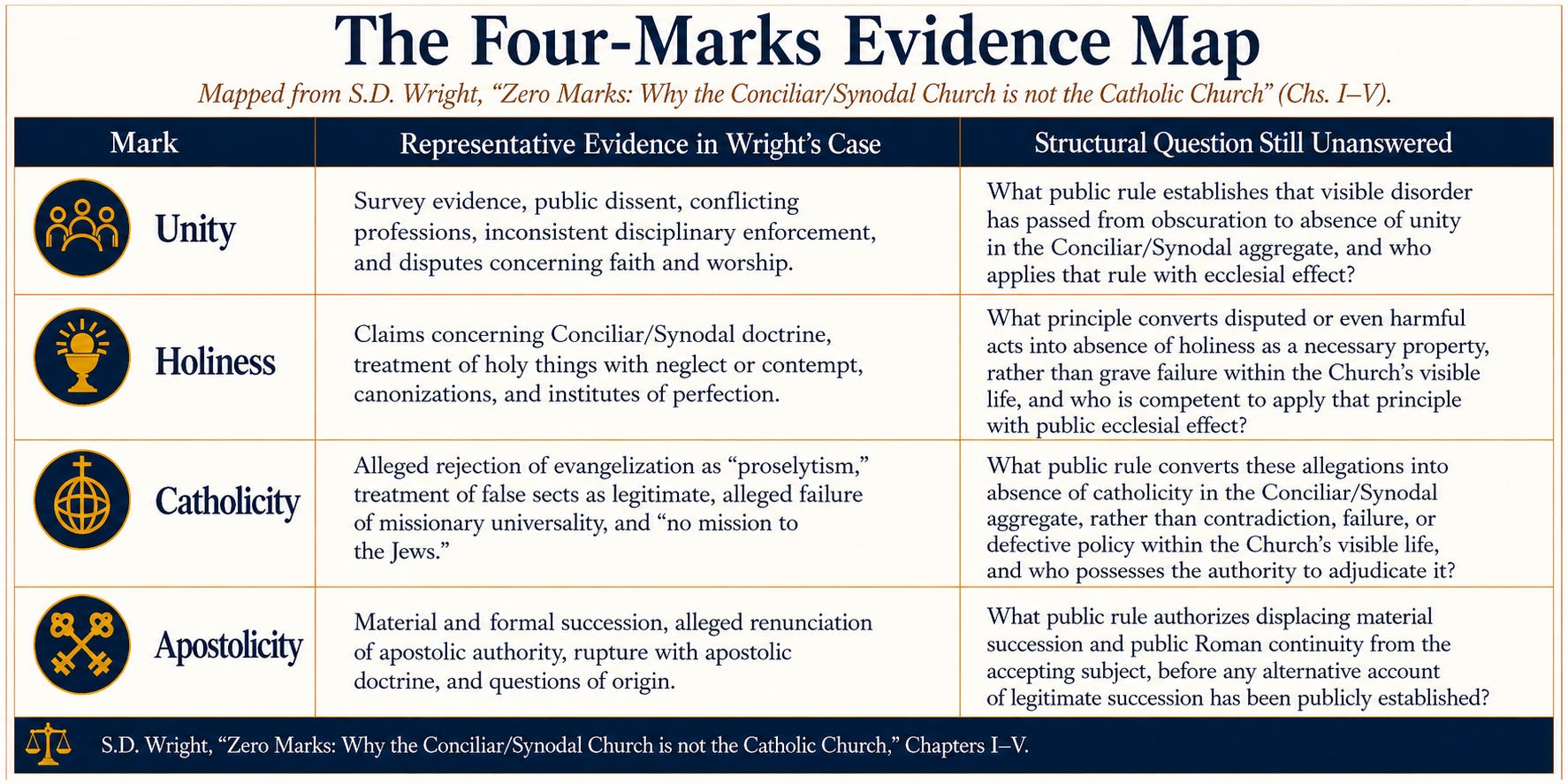
S.D. Wright’s central claim is not that the postconciliar order has been wounded. It is that the necessary properties signified by unity, holiness, catholicity, and apostolicity are absent from the Conciliar/Synodal body. His published chapters treat the marks in turn: unity, holiness, catholicity, and then apostolicity, considered first as a note and then as a property. The unity chapter invokes survey evidence, including the 2014 Univision Global Survey of Roman Catholics. The later chapters address alleged defects in holiness, missionary catholicity, material and formal succession, apostolic doctrine, and origin. [6]
The familiar appeal to sinners, dissenters, scandals, and earlier periods of crisis does not answer this claim. Wright distinguishes an obscured note from an absent property. The decisive question is what rule establishes the passage from the first to the second.
Wright does not rest his case merely on accumulation language. He argues that a necessary property, if visibly absent, proves that the body is not the Church, and he treats radical disunity and an officer’s open denial of catholicity de jure as categorical instances of such absence. [6] That is a categorical inference, not simply a larger catalogue.
That formulation sharpens, but does not remove, the threshold question. Whether a person is a public heretic in the relevant sense, whether a text or act expresses the body’s profession, and whether a claimed departure actually excludes a property rather than manifests disorder within the Church are themselves contested transitions. The argument still needs an identified rule of competent application and public ecclesial effect.
A visible Church cannot be reclassified by an accumulation standard that changes with each evaluator’s reading of texts, history, surveys, episcopal statements, pastoral practice, and institutional disorder. The critic must show why the evidence proves the absence of a necessary property of the Church herself rather than grave disorder within her. That problem applies to unity and holiness alike.
The marks are public signs, not self-executing instruments by which each observer may redraw the Church’s boundaries once a crisis appears sufficiently severe. Severity and loss of ecclesial identity are different judgments. The latter does not follow from the former without a rule governing the transition.
Historical novelty does not create a theological exception. Even an unprecedented crisis requires a public, tradition-grounded rule establishing why the Church’s ordinary public signs no longer govern the question of her visible head.
Authority, Object, and Effect
The evidence map requires a further discipline: not every kind of evidence carries the same authority or proves the same thing. Every disputed act must be identified by its issuing authority, exact object, and alleged ecclesiological effect. A papal interview, a conciliar text, a dicasterial document, a disciplinary provision, an episcopal conference statement, an abuse, a failure of enforcement, and a survey result do not have the same authority or the same relation to the Church’s public profession.
The same is true of worship-based or lex orandi arguments. A liturgical text, rite, abuse, permission, implementation, or pattern of practice must still be classified by authority, object, and asserted ecclesiological effect before it can be treated as proof of corporate identity loss.
A catalogue does not become a single proof of ecclesial reclassification merely by growing longer. None of this denies that serious evidence exists. It denies only that evidence, however extensive, converts on its own into the conclusion the critic needs.
A critic might point to a document that seems ambiguous, a disciplinary measure that seems harmful, a policy that seems imprudent, an act that conflicts with prior doctrine, or a public failure that is scandalous. None of those examples, however, establishes that the historically continuous hierarchy has become another ecclesial body. That conclusion goes beyond what the evidence, even when properly classified, establishes on its own.
Moving from evidence of disorder to ecclesial reclassification requires a public, tradition-grounded rule governing that inference. No such rule has been supplied.
The distinction protects both sides from category error. It prevents a defender of the visible hierarchy from treating every act as equally protected merely because it proceeds from the hierarchy. It also prevents the critic from treating every official act as a corporate profession of another religion merely because it occurs within the same visible order. The authority claimed by the act, the object of the act, and the effect asserted from the act must remain distinct.
The Boundary Allocation Problem
Wright’s own precision creates a practical burden. He does not say that every person connected with the Conciliar/Synodal body is non-Catholic. He says the aggregate includes Catholics and non-Catholics and that its public boundaries do not coincide with the boundaries of the Catholic Church.
Once that is claimed, an alternative public boundary is required.
Wright does offer a member-level answer. He describes the Church as the congregation of baptized men who profess the external faith, remain subject to legitimate pastors, and remain in communion, and identifies, at least in the Western world, “the body of traditionalists” together with some conservatives whom he regards as materially entangled with the Novus Ordo structure. He acknowledges that the exact boundaries are difficult to determine and appeals, through Billot, to moral certainty concerning most members. [11]
Which bishops presently possess lawful jurisdiction? Which dioceses remain Catholic jurisdictions? Which offices are truly held? Which clergy possess a lawful mission to teach and govern? Which public acts bind the faithful, and which do not? By what public criterion are the Catholic parts distinguished from the non-Catholic parts within the same visible structure?
Those questions identify the level at which Wright’s thesis must operate if it is to defeat UPA. The issue is not merely whether individual Catholics can be located within a compromised visible order. The issue is whether the Church’s public juridical order can be identified once the ordinarily visible Roman structure is excluded from the accepting subject.
The argument does not demand a completed recovery blueprint, a roster of every surviving jurisdictional bishop, an immediate conclave plan, or a final resolution of every question about mission, extraordinary supply, material succession, and recovery. Those matters are reserved for Essay 9.
But a thesis used now to exclude the ordinarily visible hierarchy from the accepting Church must supply a presently operative public criterion. It must identify, at minimum, who counts as the Church now, who possesses authority now, and why the public reception of the claimant does not count as UPA now.
Wright’s member-level answer does not discharge that burden. It presupposes the doctrinal sorting in dispute by treating the profession of the true faith as already sufficient to separate the traditionalist body from the ordinarily visible Roman order. And it identifies members rather than the juridical society: it does not identify which bishops, sees, jurisdictions, missions, and binding acts constitute the Church’s public order. A principle used to exclude the ordinarily visible hierarchy from the accepting subject must do that further work.
Wright’s own hierarchy-status essay illustrates the distinction between possibility and identification. He expressly treats the possible survival of residential bishops or equivalents as an apologetic response to an impossibility objection, while acknowledging uncertainty about the actual continuity of the hierarchy. A possibility argument may rebut an assertion that no continuity could exist. It does not identify the body that actually constitutes the Catholic hierarchy now. [8]
A cautious refusal to invent such a roster is not itself a defect. For purposes of the argument, one may grant that a remnant hierarchy could exist without Wright being able to identify every member of it. That concession does not establish that such a hierarchy is publicly identifiable in the manner required by the Church’s visible and juridical constitution.
But the moment that same theory uses that possibility to deny that the public Roman hierarchy is the accepting Church, more is required of it. At that point, it needs a criterion that actually works today, not merely one that might work in principle. It must tell Catholics why the visible Church in front of them is excluded, and what body, if any, stands in her place.
Possibility is not identification.
Charles Journet Does Not Authorize Wright’s Exception to UPA
The sequence Wright’s argument requires has now been traced. Charles Journet provides an important check on Wright’s use of the notes. Wright’s appeal to Journet requires a distinction between the limited premises Journet allows and the decisive exception he does not authorize. Journet does not treat numerical diffusion as a crude headcount test. He recognizes that claims of universality and continuity may require careful application amid historical confusion, and that dissidence or innovation may bear on the question of rupture. [5] [11]
Wright’s published appeal is not merely a point about numbers. He invokes Journet’s supplementary criteria of fidelity to the faith of the fathers, antiquity against alteration, and universality, and says that he affirms rather than denies Journet’s Petrine resolution. He also acknowledges that the ordinary theological treatment of the notes was not framed for precisely the identification problem he says the present crisis raises. [11]
That concession does not license the decisive displacement. Journet’s criteria may bear on an alleged innovation or rupture; they do not authorize a freestanding private audit that first disqualifies the historically continuous Roman hierarchy. When the criterion of universality becomes ambiguous, Journet resolves that ambiguity through Peter and the Roman Church. The true universality is the universality centered on Peter: “where Peter is, there will be the Church.” He concludes that the argument from universality receives its final precision through the Roman Church. [5]
Journet’s treatment of papal election confirms the same order. He recognizes that an election may be defective through an unqualified elector, a defect of form, or an incapable subject. Yet he says that peaceful acceptance by the universal Church of an elect as the head to whom she submits is an act in which the Church “engages herself and her fate,” and therefore “an act in itself infallible.” The conditions prerequisite to a valid election are thereby known mediately. Acceptance may be negative, when the election is not promptly contested, or positive, when it begins with those present and spreads to the rest of the Church. [5]
His treatment of the doubtful-pope maxim follows the same sequence. The maxim governs while doubt remains, before the universal Church’s tacit consent has remedied possible defects. Journet then follows John of St. Thomas’s example of how a doubtful pope is actually judged: the Council of Constance, a public ecclesial body invoked amid the Western Schism, not by private evaluation.
Journet does not hold that the Church manufactures papal jurisdiction or cures a real antecedent defect by human recognition. He distinguishes the Church’s role in designation from Christ’s conferral of the pontificate and treats the universal Church’s genuine peaceful acceptance as the public and divinely protected sign from which the relevant conditions of legitimacy are known. The Church has a right to certain knowledge of who is elected; where peaceful and certain election is not yet apparent, the election is regarded as still in process. [5]
Wright’s Conditional Use of Journet
Wright does not simply deny the doctrine of peaceful acceptance. He argues that the postconciliar claimants have not received the genuine peaceful and universal adherence contemplated by Journet. Essay 3 addressed that claim at the level of reception: resistance to particular teachings or acts does not itself show that the Church refused to receive the claimant as pope. Essay 2 addressed the related argument that the Church’s later acceptance cannot make a man pope if a disqualifying defect remained in place from the beginning.
The Zero Marks argument supplies the broader premise. Because the Conciliar/Synodal aggregate is said not to be identical with the Catholic Church, it is also said not to be the accepting subject presupposed by Journet. [6] [11]
The disagreement concerns the order of inquiry. Journet treats peaceful acceptance by the universal Church as the public sign from which the conditions of validity are known. Wright requires private observers first to decide whether the claimant was eligible, whether the adherence was genuine, and whether the body receiving him was still the Catholic Church. A condition UPA presupposes thus becomes a prior veto: the Church’s public reception cannot count until private judgment has certified the body that performed it.
Acceptance neither confers Catholicity on the accepting body nor enables a false sect to make a claimant pope merely by acclaiming him. But Journet supplies no rule by which private evaluators may suspend the ordinary public identification of the Roman hierarchy, declare that visible body non-Catholic, and then deny its reception the effect he assigns to peaceful acceptance.
Wright may test the present Roman body against the faith handed down from the fathers. Journet, however, does not treat conformity with antiquity as a stand-alone test. He joins the witness of antiquity to the Church’s universal profession, and he identifies that universality through Peter and Rome. Nothing in the cited material allows private observers to set the Roman communion aside first and then treat its reception of a pope as having no ecclesiological significance.
Wright invokes Journet, but Journet does not provide the private exception his argument requires.
Two Routes, One Final Question
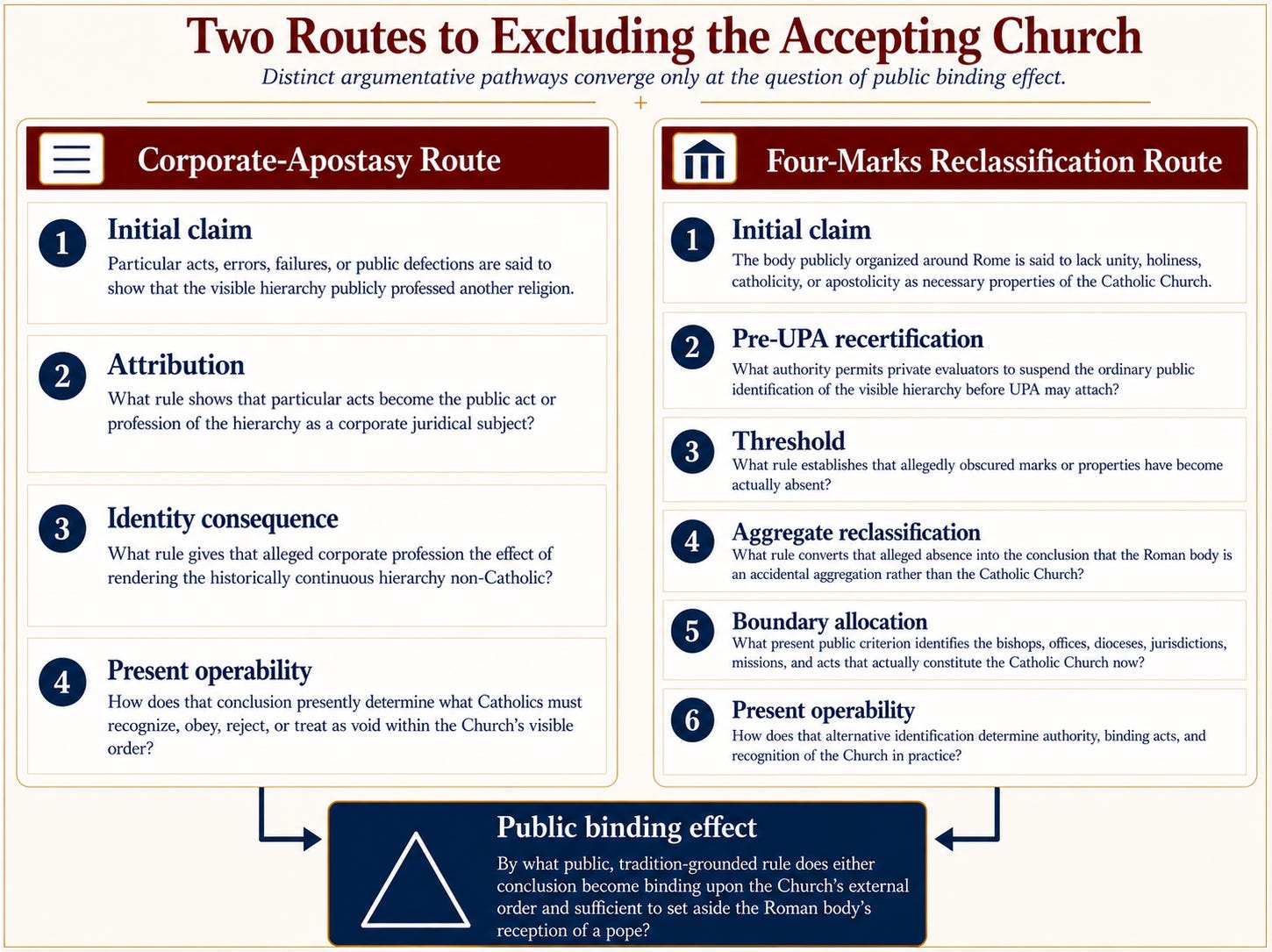
The redefinition move has appeared thus far in two principal forms that must remain distinct. The first is Wright’s four-marks route, already examined. The second argues from particular acts, statements, errors, failures, or public defections to the conclusion that the visible hierarchy as a corporate juridical subject publicly professed another religion.
The first route requires a pre-UPA recertification rule, a threshold from obscured to absent marks, an aggregate reclassification of the accepting body, a publicly intelligible allocation of ecclesial boundaries, and a rule of present operability. The second requires an argument from attribution, identity consequence, and present operability. Neither route may borrow the other’s unproved transitions.
They converge only at the final question:
By what public rule does a private theological reclassification become binding upon the Church’s external order?
Present operability is a practical test: does a theory function here and now for those who already accept it, telling them who holds authority and what must be recognized, obeyed, or refused?
A theory can pass that internal test and still fail the harder question this essay has pressed throughout: what public, tradition-grounded rule makes its conclusion binding on the whole Church, not just on those who already accept its premises?
Attribution and Consequence
The corporate-apostasy route mapped above requires two distinct propositions. Attribution asks how particular acts, errors, statements, policies, or failures become the public profession of the hierarchy as a corporate juridical subject. Consequence asks what preconciliar or manualist rule gives that alleged corporate profession the specific effect of rendering the historically continuous hierarchy non-Catholic for purposes of UPA.
Neither proposition follows automatically from the other. A catalogue of actions may establish that a crisis is grave. It does not itself establish that the hierarchy acted corporately as a single subject. Nor does even a demonstrated corporate act automatically establish the ecclesiological consequence needed to exclude the hierarchy from UPA’s accepting subject.
The claim that the visible hierarchy has publicly professed a different religion cannot serve as a neutral starting point. It is the conclusion that must first be established before the ordinary visible hierarchy can be excluded. The critic must still establish that the acts are attributable to the hierarchy as a corporate subject, that this corporate act renders the hierarchy non-Catholic, and that this conclusion can presently determine, in practice, what Catholics must recognize, obey, reject, or treat as void. That remains distinct from the further question of what would make the conclusion binding upon the whole Church. Stating the conclusion as a description does not discharge those burdens.
Two clarifications keep the fault line clean. UPA does not create the Catholicity of the accepting Church. UPA does not establish its own subject merely through acceptance.
The remaining dispute is whether the visible hierarchy satisfies the condition of Catholicity that UPA presupposes. Once the issue is stated that way, the pro-UPA argument is not circular. It requires the objector to supply the public ecclesiological rule by which the ordinarily visible hierarchy is excluded from the accepting subject.
The Individual-to-Corporate Inference Gap
The corporate-apostasy route usually depends upon an unproved scaling move. Authorities often invoked in support of that move include Bellarmine on manifest heresy, Canon 188, n. 4 of the 1917 Code, under which an ecclesiastical office became vacant ipso facto and without formal declaration if its clerical holder publicly defected from the Catholic faith, and Wernz-Vidal’s discussion of a Roman Pontiff who later falls into notorious, publicly propagated heresy. The present essay does not adjudicate the scope, conditions, or concrete application of those authorities.
Even if each were granted in the strongest form appropriate to the argument, they concern the visible membership, ecclesial standing, or possible loss of office of particular persons. Extending those principles from individual cases to the identity of the Church as a juridical society requires a separate rule.
A conclusion about one bishop’s standing does not decide the juridical status of another bishop, the continuity of every diocese, the validity of every office, or the identity of the Church herself. A conclusion about many individual cases does not become a conclusion that the Catholic Church as a juridical society has publicly professed another religion merely by multiplication.
The further transition requires a doctrine of attribution, representation, corporate identity, and public effect. The seriousness of the individual cases does not supply that doctrine. More examples may increase the number of individual cases. They do not create the missing corporate rule.
The same point applies to tolerated error and institutional failure. Tolerance, silence, circulation, non-enforcement, or coexistence may be evidence in an argument about the state of the Church. They are not interchangeable with a corporate public profession by the Church as a juridical subject. The stronger the identity consequence claimed, the more exact the attribution must be.
The burden cannot be met by restating the conclusion as a description. Doing so does not supply the missing corporate rule; it merely assumes the scaling move this section has shown remains unproved. What is still needed is a rule converting individual cases, tolerated error, and institutional failure into a corporate profession carrying public ecclesiological effect, not a repetition of the label itself.
Fr. T. J. Ojeka’s Doctrine-First Gateway
Fr. T. J. Ojeka writes from an explicitly sedevacantist framework and publicly states that he holds the Roman See to have been vacant since 1958. The argument considered here is assessed on its own stated premises.
In his June 26, 2026 reply to Essay 1, he presents a compressed doctrine-first objection to UPA: whether the faith professed today is the same faith professed yesterday must be settled before acceptance, recognition, visibility, or institutional continuity can carry force. His later SSPX article states the same priority more openly: the prior question is whether an authority that publicly teaches, legislates, or promotes what appears contrary to the previous universal Magisterium can still exercise legitimate Catholic authority “in the full sense.” [9]
Authority is ministerial rather than creative, and public recognition cannot make contradiction true. UPA neither manufactures Catholicity nor turns a disputed doctrine into orthodoxy. But an alleged doctrinal rupture does not by itself establish that the historically continuous Roman hierarchy ceased to be the Catholic accepting Church. Ojeka must still identify the rule that attributes the alleged defect to the hierarchy as a corporate body, translates it into loss of ecclesial identity, and gives that conclusion public effect. Until that step is supplied, his doctrine-first priority remains an argument for investigation, not a determination that UPA cannot attach.
Ojeka treats alleged contradiction as proof that the visible hierarchy lacks Catholic authority in the full sense. That judgment excludes the hierarchy from UPA’s accepting subject, and the resulting reclassification is then used to deny the force of its public reception.
In his Section III reconstruction, Ojeka frames the alleged circle as a sequence from the visible Church’s acceptance of a claimant, to his papal status, to the Catholicity of the accepting Church, and then objects: “But step three is simply assumed.”
The upper panels of the chart below show why that reconstruction reverses the stated order of the argument. Essay 1 expressly denies that acceptance creates the Catholicity of the accepting Church. [9]
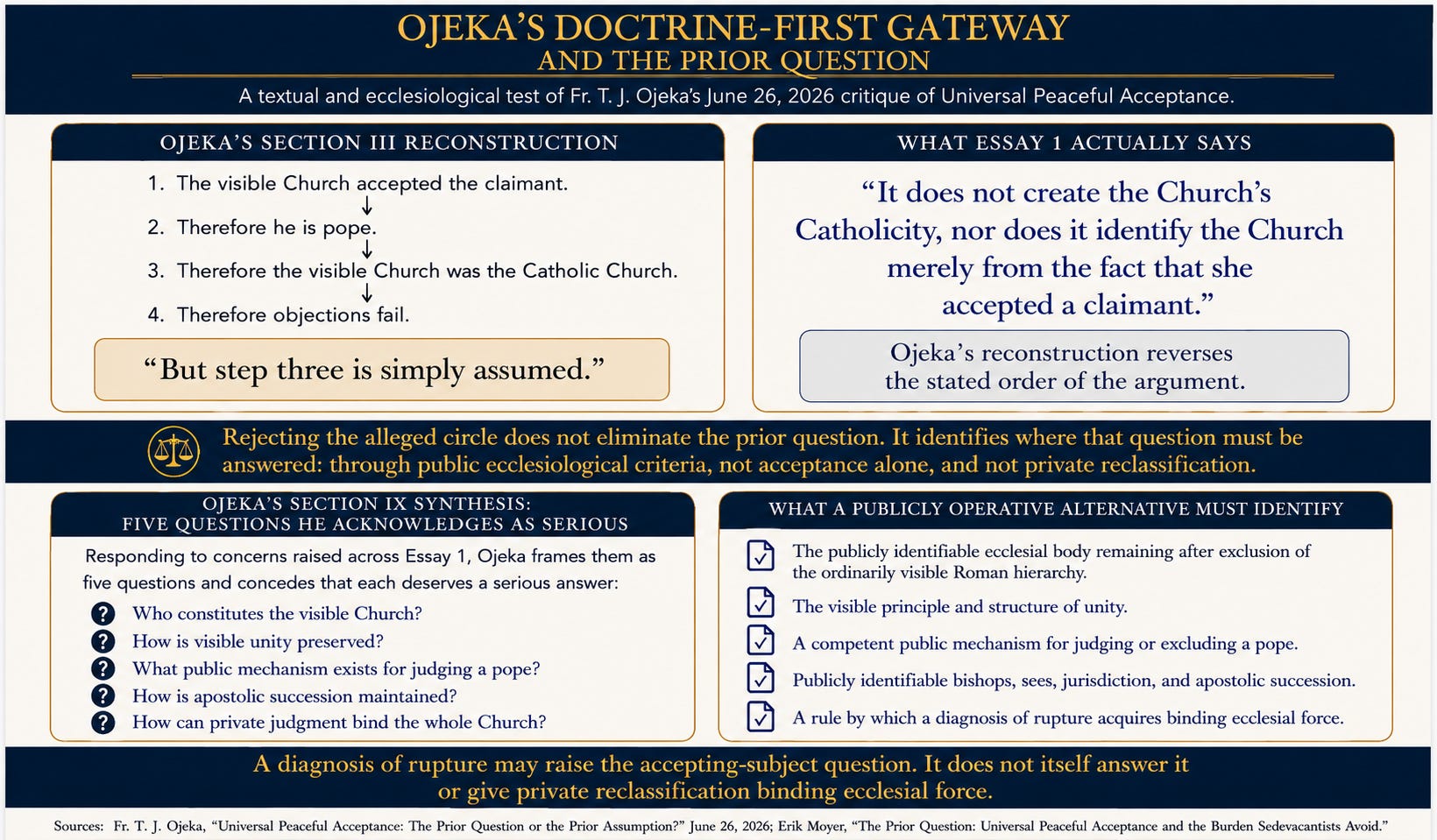
Ojeka’s causal criticism also attributes to UPA a function the manualist claim denies. Wernz-Vidal state that the Church’s acceptance is not the cause of a valid election but its infallible sign and effect. Acceptance does not make a disqualified man pope or cure a persisting impediment. On the manualist account, it certifies that the conditions required for legitimacy were satisfied. [3]
Billot, John of St. Thomas, and Wernz-Vidal do not restrict that certainty to procedural defects. They treat the Church’s acceptance as certifying the conditions required for legitimacy. [1] [2] [3] Ojeka therefore must identify from comparable authority the rule by which an alleged doctrinal contradiction prevents the visible Church’s reception from carrying the evidentiary force those authors assign to UPA.
Ojeka also says that answers to the five questions have been supplied through the Church’s inherent power of self-preservation, “with varying degrees of clarity and intensity.” But the cited post identifies no governing rule, competent subject, or present mechanism by which that appeal resolves them. [9] Nor does it explain how Catholics can presently know who holds office, what jurisdictions and missions remain, which acts bind, or who can settle the papal question.
His criticism of the SSPX brings the practical difficulty into sharper focus. The tension between recognizing an authority and resisting acts judged harmful is real. Denying the visible hierarchy’s Catholic authority, however, transfers rather than resolves the problem. The resulting theory must still identify the Church and authority that remain and explain how its conclusion acquires ecclesial effect.
Ojeka’s route differs from Wright’s four-marks argument, but it reaches the same unresolved point. An appeal to self-preservation may explain why the Church cannot simply disappear. Without a public rule identifying how her authority and external order continue, it does not determine who presently governs or why the visible hierarchy’s reception cannot count. The chart marks that present-operability problem while leaving the fuller questions of mission, recovery, and restoration to Essay 9.
Indefectibility and the Prior-Reclassification Claim
A related argument uses indefectibility as a gateway to the claim that the accepting body was not Catholic. Stated at full strength, the argument is that the Church cannot give a false rule of faith, evil worship, or universal doctrinal error; the postconciliar papal line is alleged to have authorized precisely such things; therefore the papal claimants who presided over that line cannot have possessed true authority, and the hierarchy that received them cannot have performed the reception contemplated by UPA.
This is a serious attempt to protect a genuine dogma.
The present essay need not adjudicate every doctrinal, liturgical, or disciplinary allegation to identify the missing transition. Even if the alleged defects were granted for argument’s sake, indefectibility would not by itself authorize private or minority observers to determine, with public binding effect, that the ordinarily visible hierarchy was not the Church at the time of reception. An alleged crisis implicating indefectibility cannot be resolved by silently suspending the public signs through which indefectibility is ordinarily known.
As with the threshold argument, novelty supplies no authority. An unprecedented crisis still requires a tradition-grounded public rule before the Church’s ordinary public signs can be set aside on the question of her visible head. The later-loss, notoriety, visible-succession, and extended-vacancy questions are distinct and are reserved for Essays 6, 7, and 9. [12] The narrower point here is that alleged defects in official acts cannot, without a demonstrated rule, first exclude the accepting Church before UPA may attach.
The Formal Operative Severance
A related escape route concedes that the Church remains publicly identifiable in some sense while denying that the visibly continuous hierarchy possesses present lawful mission, formal jurisdiction, or governing authority in act. Its variants distinguish material from formal succession, legal occupation from formal mission, or visible titles from the authority to teach, govern, and sanctify. Wright’s apostolicity chapter itself distinguishes material succession from formal succession and grants that the Conciliar/Synodal body has a strong claim to material succession while arguing that this does not settle legitimacy. A related Cassiciacum formulation retains legal occupation and material succession while denying ordinary mission and jurisdiction. [10]
The question here is narrower than the later recovery questions these theories raise. By what public, tradition-grounded rule does the same visible Roman order remain sufficiently continuous to preserve titles, material succession, an electorate, or selected institutional effects while being insufficiently Catholic to receive a Roman Pontiff with the evidentiary force the manualists assign to UPA? The UPA authorities do not say that the Church confers papal jurisdiction. They say that her universal peaceful reception is the divinely protected sign that legitimacy is present.
A theory that preserves visible continuity for institutional purposes while denying that continuity the ordinary evidentiary force of UPA must identify the rule authorizing the division. The fuller questions of supplied power, material electors, mission, and recovery are reserved for Essay 9. A distinction that cannot be publicly known and applied cannot supply the visible rule of recognition the Church requires. Journet’s own distinction between material succession, partial apostolicity, and plenary apostolicity also cautions against treating sacramental continuity or remnant clergy as equivalent to a publicly governed apostolic hierarchy with lawful mission. [5]
The Manualist Order and the Shared Burden
The preceding sections have traced several ways of excluding the ordinarily visible Roman hierarchy from the Catholic accepting subject of UPA. Beneath their differences lie two competing orders of inquiry. The redefinition move begins with the crisis. It conducts a private audit of doctrine, worship, discipline, succession, governance, and visible unity. It reclassifies the public Roman body as non-Catholic. It then concludes that UPA never attached.
The manualist order begins from the visible Church as a publicly identifiable society. It recognizes the Church’s corporate reception of a claimant as Roman Pontiff. It treats that reception as a divinely protected sign of legitimacy. It does not make the Church the cause of papal authority. It treats the Church’s reception as the public effect and sign of an authority Christ has already conferred.
The redefinition approach makes the identity of the accepting Church depend upon a prior private judgment that can always be reopened by presenting further evidence. The manualist approach permits exclusion of the ordinarily visible Church only where a public, tradition-grounded rule establishes why she no longer counts as the Church in the concrete case.
This essay does not claim that the postconciliar crisis is imaginary, that every disputed act is sound, that the marks reduce to a headcount, or that no public rupture could ever bear upon membership or office. It does not demand a complete future recovery plan from every critic before any present argument can be made.
Its conclusion is narrower and decisive. A theory that excludes the ordinarily visible hierarchy from the Catholic accepting Church today must identify a presently intelligible public criterion by which Catholics know who the Church is today, who possesses authority today, and why the visible Church’s public reception of a claimant as pope does not count as UPA today.
Wright’s four-marks route, the corporate-apostasy route, Ojeka’s doctrine-first gateway, the indefectibility gateway, and formal-operative severance are distinct forms of the same accepting-subject challenge. They do not replace the series’ earlier map of anti-UPA arguments. Rather, they identify the principal forms that challenge takes here: each argues, by a different route, that the ordinarily visible Roman hierarchy cannot function as UPA’s Catholic accepting subject.
These routes differ in form, but they share the same unresolved problem. None defeats UPA merely by presenting serious evidence of postconciliar disorder or by naming a dogma the Church must preserve. Each must establish the public, tradition-grounded rule that gives its conclusion ecclesial effect against the visible Church’s public reception of a claimant as pope.
Historical analogy to earlier schisms, ruptures, or disputed authorities does not supply that rule. Such analogies may illuminate the kind of crisis alleged. They do not identify who is presently competent to apply them or what public act makes the resulting conclusion operative in the Church.
The marks, doctrine, and the crisis retain their full importance. But a conclusion about the Church’s corporate identity carries a burden distinct from the evidence offered to establish doctrinal disorder. This essay identifies that burden; later essays address the distinct questions of alleged later loss, extended vacancy, mission, recovery, and the public constitution of any alternative order.
Without that public rule, the redefinition move does not defeat Universal Peaceful Acceptance. By first recasting the accepting body as non-Catholic or otherwise incapable of supplying UPA, it merely places its conclusion inside its own premise.
Sources
1. Louis Billot, S.J., Tractatus de Ecclesia Christi sive continuatio theologiae de Verbo Incarnato, Tomus Prior, 3rd ed. (Prati: Ex Officina Libraria Giachetti, Filii et Soc., 1909), 620-621.
2. John of St. Thomas, O.P., Cursus Theologicus, Tomus Septimus in Secundam Secundae (Parisiis: Ludovicus Vivès, 1886), Tractatus de Auctoritate Summi Pontificis, Disputatio II, Articulus II, pp. 228–251, especially nos. X, XI, XII, XXVIII, and XXXIV. The Latin text and pagination have been verified directly against the 1886 Vivès facsimile.
3. Franciscus Xaverius Wernz, S.J., and Petrus Vidal, S.J., Ius Canonicum ad Codicis Normam Exactum, vol. II, De Personis, 3rd ed., rev. Filippo Aguirre, S.J. (Rome: Apud Aedes Universitatis Gregorianae, 1943), n. 454, pp. 520-521.
4. Johann Baptist Franzelin, S.J., Theses de Ecclesia Christi: Opus Posthumum (Rome: Ex Typographia Polyglotta S.C. de Propaganda Fide, 1887), 232, 234.
5. Charles Journet, The Church of the Word Incarnate, vol. I, The Apostolic Hierarchy, trans. A. H. C. Downes (London and New York: Sheed and Ward, 1955), 481-482, 532-538.
6. S.D. Wright, Zero Marks: Why the Conciliar/Synodal Church is not the Catholic Church, five chapters and conclusion, The WM Review, March-May 2026, especially Chapter I, Disunited in Faith; Chapter II, Comprehensive Rejection; Chapter III, Is the Conciliar/Synodal Church Catholic?; Chapter IV, Apostolic succession in the Conciliar/Synodal Church?; Chapter V, Ruptures with apostolic doctrine and origin; and Hovel in the valley. The series is used as an adversarial-position corpus. Its cited authorities, survey data, historical claims, translations, and theological conclusions are not adopted affirmatively unless independently verified in this essay’s source record.
7. S.D. Wright, Radically insufficient: Reply to Fr Crean on the Church’s visibility, Part I, The WM Review, 2026. Used solely to state Wright’s published visibility framework as he presents it.
8. S.D. Wright, “The status of the Church’s hierarchy today,” The WM Review, April 15, 2026. Used solely for the stated distinction between a possibility argument concerning hierarchy and an identification of the actual hierarchy.
9. Fr. T. J. Ojeka, “Universal Peaceful Acceptance... or Universal Peaceful Confusion?” (May 25, 2026); “Universal Peaceful Acceptance: The Prior Question or the Prior Assumption?” (June 26, 2026); “SSPX Saga: Unmasking the Fruits of Novus Ordo Catechesis” (July 6, 2026); and author profile statement, Fr. T. J. Ojeka’s blog. Used solely to identify Ojeka’s publicly stated framework and to document his doctrine-first, circularity, and legitimacy objections; his embedded historical, canonical, and theological authorities are not adopted except where independently verified.
10. S.D. Wright, Apostolic succession in the Conciliar/Synodal Church? (Zero Marks, Ch. IV), The WM Review, April 2026. Used solely to state the material-formal succession distinction in Wright’s published argument. This essay does not adopt the historical or theological authorities Wright cites for that distinction without separate verification.
11. S.D. Wright, “How do you tell the true Church after a rupture? Journet’s answer” (March 24, 2026); “Life is full of disappointments – Responses to some objections” (May 21, 2026); “Who can elect a Pope? (Fr Ricossa)” (March 9, 2026); and “Fake conclave, true pope?” (April 23, 2025), The WM Review. Fr Hervé Belmont, “’The Cassiciacum Thesis’ – an explanation for the current crisis in the Church?” trans. The WM Review, ed. S.D. Wright (August 1, 2024). Used solely to state Wright’s published treatment of Journet, membership, and peaceful acceptance, and the asserted conditions of his exception, and Belmont’s published exposition of the Cassiciacum thesis as edited and annotated by Wright.
12. S.D. Wright, “’Spotless and Unsullied’ – Indefectibility and the Extended Vacancy,” The WM Review, June 9, 2026. Its published contents (Chapters I and II as of this writing) identify later treatment of indefectibility, continuity of the hierarchy, and the right of election. No argument from unretrieved or nonpublic portions of that series is relied upon here.
Universal Peaceful Acceptance Series
Essay 1: The Prior Question: Universal Peaceful Acceptance and the Burden Sedevacantists Avoid
Essay 5: The Hidden Premise: Universal Peaceful Acceptance and the Claim That the Accepting Church Is Not Catholic
Essay 6: Bellarmine and the Vacant See: Manifest Heresy, Ipso Facto Loss, and Why Later Loss Does Not Undo Universal Peaceful Acceptance (forthcoming)
Essay 7: The Empty Chair Problem: Universal Peaceful Acceptance and the Burden of Visible Succession (forthcoming)
Essay 8: The Benedict XVI Resignation Argument: A Factual-Canonical Challenge to the 2013 Conclave, Not a Refutation of Universal Peaceful Acceptance (forthcoming)
Essay 9: The Cost of Denying Universal Peaceful Acceptance: Visibility, Indefectibility, and the Cascading-Defect Problem Raised by Pope Leo XIV's Election (forthcoming)
Visuals disclosure: The cover image and charts were created with the assistance of generative AI under my direction. I verified that the charts accurately reflect the essay’s argument and cited sources. The charts are included to clarify the argument and make its structure easier to follow.
If only we had a time machine, and we could fix our mistakes from the beginning
Thanks for posting